Day 1 is over and what a day it was.  The weather improved and for the first day we saw not a drop of rain. The sun broke through on multiple occasions and helped raise everyone’s spirits even as the gradient of the climbs tried to knock them back down.
  Sonthofen put on a great start and we had a neutral roll out for about 8 km before the race was on. Racing began at the bottom of the first big climb; (profile is here) the Oberjoch and pretty much everyone pinned it up to the top. Once up to the top the pack riding began and we motored through some rolling terrain. It was pretty cool looking down at your speedo and seeing 40+ km/hr as we booted along. The race started to sort itself out as the faster riders in the deeper start blocks started to move their way through the field, and the slower riders from the early start blocks made their way to the back. As a team, Dave and I learned some early lessons that being at the back of a pack or a pace line was not the ideal place to be. Although initially it seemed like everyone on the line was riding at the same pace, it soon became obvious that the weaker riders would collect at the back, and if the grade or pace increased just a bit they would be popped. If you were behind them by the time you had a chance to move around them, it became a real challenge to bridge back up to the faster group ahead.
The first descent was too cool. Ripping down the hill at 60+ and having the road “mostly” controlled allowed you to dive into the corners and rip out the other side. My anxieties about pack descending did not prove founded as my speed was pretty comparable to those around me and there were not a huge numbers of riders cutting across my line.
The scenery was spectacular, especially as we rolled out of Stanzach. Exiting the town, we were on a straight section of road and could see ahead the first several km of the last climb. It was quite intimidating as it was cut into the side of the mountain, and basically heading straight out of the valley. The last climb was a brute, with several kilometer long sections of 12-13% gradients. The last 2 km were particularly daunting as it switched up the mountain with little kickers every few 100 m. The 20 km long descent off the other side was almost as crazy with speeds in excess of 70 km/h. I personally have never reached those sorts of speeds on a bike and I have to admit that a few times I was quite nervous about the possibility of flatting. In the end we made it to Imst. One day down, six more to go. (Results here)
The weather improved and for the first day we saw not a drop of rain. The sun broke through on multiple occasions and helped raise everyone’s spirits even as the gradient of the climbs tried to knock them back down. Sonthofen put on a great start and we had a neutral roll out for about 8 km before the race was on. Racing began at the bottom of the first big climb; (profile is here) the Oberjoch and pretty much everyone pinned it up to the top. Once up to the top the pack riding began and we motored through some rolling terrain. It was pretty cool looking down at your speedo and seeing 40+ km/hr as we booted along. The race started to sort itself out as the faster riders in the deeper start blocks started to move their way through the field, and the slower riders from the early start blocks made their way to the back. As a team, Dave and I learned some early lessons that being at the back of a pack or a pace line was not the ideal place to be. Although initially it seemed like everyone on the line was riding at the same pace, it soon became obvious that the weaker riders would collect at the back, and if the grade or pace increased just a bit they would be popped. If you were behind them by the time you had a chance to move around them, it became a real challenge to bridge back up to the faster group ahead. The first descent was too cool. Ripping down the hill at 60+ and having the road “mostly” controlled allowed you to dive into the corners and rip out the other side. My anxieties about pack descending did not prove founded as my speed was pretty comparable to those around me and there were not a huge numbers of riders cutting across my line.
The scenery was spectacular, especially as we rolled out of Stanzach. Exiting the town, we were on a straight section of road and could see ahead the first several km of the last climb. It was quite intimidating as it was cut into the side of the mountain, and basically heading straight out of the valley. The last climb was a brute, with several kilometer long sections of 12-13% gradients. The last 2 km were particularly daunting as it switched up the mountain with little kickers every few 100 m. The 20 km long descent off the other side was almost as crazy with speeds in excess of 70 km/h. I personally have never reached those sorts of speeds on a bike and I have to admit that a few times I was quite nervous about the possibility of flatting. In the end we made it to Imst. One day down, six more to go. (Results here)


 I picked this location as our jump off point because there is some really spectacular scenery in the local area and it is just a short ride to Sonthofen. Yesterday we tooled around Fussen and checked out the Neuschwanstein castle.
 Our intention was that after lunch we would spin our way to Sonthofen. As fate played with us, it started to pour as we toured the castle and despite waiting through lunch for the rain to stop, it did not let up. Plan B quickly became “Let’s drive to Sonthofen and maybe get a ride in there.” The drive was spectacular and by pure chance (we were following the GPS directions) we drove right down the first climb that we will attempt in the race. Everybody’s eyes tuned in and we surveyed the first of many climbs we will see in the week ahead. Much bravado filled the van about how it did not seem particularly intimidating. I guess time will tell!
 Everyone hunkered down under the awning and we all got to know each other a bit better.
 My partner is Dave MacLennan who is a colleague from work. This is his first road race also and he is a little leery as to what the week ahead will bring. I think that his biggest worry is not the length or breadth of the race (he has cycled across Canada) but the tight quarters that a peloton will bring and the possibility of “road crashes”. It is my opinion that in a lot of crashes most of the variables are out of your control. Hopefully we will be in the right place at the right time, and not the opposite.
 While my partner and I were racing the TransRockies last year we talked to several of the original organizers of the mountain bike Bike-TransAlp from Europe. We had heard about the road version of this classic race the year before, and knew that there was a good possibility that they could assist us in getting an entry. We had had such a good time racing the mountain bike version as a group of four with supporting driver that we thought why not expand the idea and bring over a larger group. In November our plans came true when we secured 10 entries. Since then we have been training hard, while looking forward to a wicked week of riding.
 Stelvio is an intimidating beast. The approach to the pass displays the entire 24.5 km., 1850 m climb including its 49 switchbacks in its entirety. Can we say “mess with your mind?” This winter I found this website that describes the difficulty of a climb in numeric terms. The formula is (H/D*100)*4 + H2/D + D/1000). My local mountain Cypress comes out with a difficulty of 76, Stelvio has a difficulty of 194! Ouch!!!!!
 Uli Stanciu says “It is not only the master route of this race, it's also the toughest stage of all Jeantex-TOUR-Transalps ever: almost 181 kilometers and a difference in altitude of 3,770 meters - that will command respect even from the best.” .
 Conditions could not have been better for racing. The last few weeks have been very dry which hardened the course up. Rain the day before the race knocked the dust down and provided a very tacky surface ideal for racing.
  A new course record was set by Max Plaxton who literally blew the field away. By the time he exited the Alice Lake loop he already had a 2 minute lead on the other elite riders and he extended from there to the finish winning by almost 5 minutes in 2:30:15
 Steed riders ripped the field. Notable results in the top 100 included Matt Green finishing in 6th, Andy Traslin in 12, Justin Mark in 38th, and Mike Traslin in 71st. The better half of the Steed team was well represented by Melanie Vaughan finishing 4th in Female Elite (116th), Carey Sather 3rd in Womens 40-49 (431st) and Calindy Ramsden 1st in Womens under 20 (476th). Full results at
  Our hotel was on the main square of Cusco and the walls of a few of the rooms dated from the Inca empire circa 1400. The quality is quite amazing; there is often less than a millimeter between adjacent blocks. The engineering and quality of the work is such that local earthquakes regularly send walls from the Spanish conquest crashing to the ground while the Inca ones remain upright and 100% intact.
 Our first ride started with a climb of about 300 m starting at about 14000 ft. Altitude has a funny way of making sure that any testosterone is checked at the door. Pretty much everyone found their own rhythm and spun up the climb, arriving at the top when their personal fitness level allowed it. Once at the top we were treated to a day of riding on a portion of the Inca trail.
  We found portions of the trail very flowy, as we cruised by small settlements and farms.
  Other sections were very technical with very steep rocky steps and significant exposure off the side of the trail.
  Two sections stand out best in my mind; the first was a technical descent through a narrow creek gorge with bridges made of weaved 1 to to 2 inch tree trunks crossing from one side to the other. The other section occurred a little later in the day as we exited the gorge and wove our way around the side of the mountain that had made up the left side of the trail. One second we were riding along in a fairly enclosed place, and the next we exploded out in to the open with the view off the right side of the trail showing a small city about 2000 ft straight down below us.
 Most of the farming was done on small terraces leveled off the side of the mountains. Surprisingly, when you think that we were riding at altitudes up to 15200 ft., one would imagine our surroundings would include massive peaks covered in snow. Perhaps because we were only slightly south of the equator there was only small amounts of snow visible and only on the occasional peak, most of which we were told had elevations in excess of 20,000 ft. Our rides in the high Andes very definitely gave you that feeling of isolation; we were riding trails that very rarely see people other that local inhabitants, let alone mountain bikers. Jayo our guide arranged for us to have lunch one day with a local farming family. Our meal consisted of locally grown corn (the kernels are three times the size that we see here in Canada) and potatoes (potatoes were first discovered in Peru and then taken back to Europe) washed down with coca leaf tea. Afterwards we were treated to a display of locally made handicrafts by the village women.
  On the last day we finished by riding right into Cusco. The view as we descended down into the city was spectacular, and as we made our way through the city we descended many sets of stairs and would our way through a maze of side streets and alley.
  Eventually we finished right in front of our hotel in the main square of Cusco…high fives all round for a wicked Peruvian adventure.
 Lima is a bustling city of about 8 million and the traffic is quite insane. Aggressive is the key word. Merging is crazy with cars coming from every direction, and vehicles passing on the outside and forcing their way to the front. I can guarantee that a normal Vancouver driver would last about 5 minutes in Lima before his car would be demolished.
  As we headed farther and farther out into the country side, we began to see more and more of the way life used to be. In particular, when we were in the high alpine on our way back to Cusco we saw many of the indigenous people in there local clothing. Of particular interest was the head gear worn by the women which told the story of the woman’s life.
  Cusco itself is bustling with many foreign trekkers; this despite the fact that the world is in an economic downturn.
  In my estimation Peru needs a place on your personal bucket list.
 Skiing or biking, your choice!
  Starting on the edge of town it climbs for 300 m with a variation of single and double track, before peaking with a neat little V trap between two trees. Then the downhill begins back into town with some really technical sandy
  After our
  Where else in the world of mountain biking can you start at an elevation of 3500 m., ride 50 km., and end up on the beach of the Pacific Ocean? The shuttle up on the bus was pretty scary with narrow dirt roads, endless switchbacks and some serious exposure over the edge. We finally started to ride only to hear by radio that the driver had managed to get stuck after he dropped us off.
 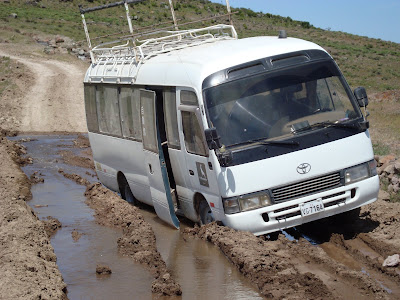 A quick return to the bus and some very muddy pushing got him unstuck and on his way to the pick up zone. This days ride had it all; rocky technical singletrack, flowy smooth paths through grass fields, steep exposed trails with wicked whoop de dos, and then this really neat kilometer wide flood plain with natural features to jump, drop off, and generally have fun.
  We finished at the beach as the sun set, but it was still warm enough for several of us to jump in and get wet.
  Our second major ride in Lima had another early start. Wake up was at 0530hr, so we could be on the bus at 0600hr for a long shuttle to a small village. We then had a horse assisted ride to an elevation of 3300m for the start of our ride in the stone forest.
  Once out of Lima and heading into the Andes we were treated to the scariest drive I have ever experienced. We followed a river up its valley, and then eventually switched back and started up the valley wall. Looking out the rear of the bus showed that the rear wheels were inches away from the edge of the road and from there, it was often several thousand feet to the bottom, and the river. The valley walls were surprisingly lush and after traversing up one side of the valley we switched over to the other side as we crossed a natural dam and then could look back and see our route. Many of us were showing a brave face but I have to say that all the windows were open and at least one of us had a hand out the window hanging on to the roof rack to assist in quick evacuation if necessary. Literally from the time we left Lima until we arrived at our destination, we were on one lane potholed dirt roads and meeting traffic presented interesting challenges. A lot of the approaching traffic were local busses packed with people and somebody had to back up. Pretty scary! Once we reached our bus destination we kitted up and shortly later our horses arrived for the last part of our shuttle. The horse that I picked turned out to be pretty skittish. In fact they eventually had to hobble him so that I could get on, Hmmm, perhaps this is not a good sign.
  As we headed out, I was the only one needing a handler connected to the horse by a rope. Was she leading the horse up the trail, noooo, she was holding the horse back. Hmmm, now I am really getting worried. Off we go heading up the trail. So what about our bikes? Well, the fit Canadians get carried up by horse, and the bikes get pushed by the local kids. Amazingly, several of them beat us to the top. As you can imagine anytime you involve a mode of transportation that has a functioning brain, the set up is ripe for some interesting stories. By the time we were half way up; my fat ass, the steepness of the trail, and the altitude had beat a little of the spunk out of Bucko. My handler then bailed and let me lose. Immediately, Bucko decided that he wanted to be off the front of the pack. About the same time, one of the horses ahead carrying Chris Winter moved a tad too close to one of the handlers. The handler whacked him on the ass and the race was on. Chris’s horse took off at a gallop, and promptly so did a bunch of the rest of them. Bucko thought this was too good to be true. Having been on a horse for a grand total of about 20 hrs in my life, I think that at first we were cantering as the trail was still pretty steep and very rocky. As soon as it flattened out just a bit, we were into a full gallop. My stirrups were way to short for me (Peruvians are not very tall) and it was all I could do to stay on the horse. I started planning exit strategies, but thankfully the steepness of the trail and its condition brought Bucko back to earth. Chris was not quite so lucky! As he passed the guys ahead of us he was teetering a little to the left. He blew by them, and the horse decided which way he wanted to go. Off he went down a different trail to a building we could see and eventually the horse stopped and Chris walked the horse the rest of the way to the top.
  Shortly thereafter we reached a really neat natural amphitheatre, and we readied for our ride. It was a short ride out of the amphitheatre to the Stone Forest. It’s kind of interesting rising at this altitude. You start off and feel pretty normal. In about 20 seconds you burn what local oxygen you have at the tissue level and then “bang” you are out of gas. The panting starts and you drop into your granny and spin the rest of the way up. Once up on the plateau we were treated to one of those vistas that just blow your mind.
  You could immediately see why this area was sacred to the Incan empire as a religious site. We slowly made our way over to some ruins taking lot of pictures, and then the downhill began.
  If yesterdays downhill scored a 7 on the difficulty scale a good portion of todays was about a 9.5 and the average was a good 8.5. Portions were relatively easy to ride and one probably could have nailed them at about 30 kph. The ringer was that the trail in places was about 2 to 3 ft wide and off the edge was a good thousand feet of vertical before you might hit the ground.
  Not the sort of place to wash out your front tire. The “fast” sections were interspersed with steep jagged rock gardens that rarely seemed to have the only “good” lines less than 6 inches from the precipitous edge. Add in the fact that you could be ripping along and come around a blind corner and meet locals with a burro train and you quickly get the picture.
  We actually had one close call as Bob Faulkner nicked a rock with his front wheel and then did a sort of summersault corkscrew as he went off the trail. Being a smart guy and understanding the 1st rule of mountain biking (live to ride another day) he grabbed for the first available piece of vegetation to slow his fall and let the bike go. Thankfully it was on one of the less “muy empinado (very steep)” pieces of trail, but it still took a good twenty minutes to find his bike farther down the slope. By the time I reached the bottom, I was pretty tired and although I hate to admit it I bailed on the last technical section and took the 10 minute road ride back to the bus. A few beverages for recovery and we were on our way back to home base in Lima. Tomorrow we are off the airport (again at 0600 hrs) for our flight to Cusco and our high altitude experience,
 After the usual “Hey anyone have an extra brake bolt, I forgot mine?” the bikes were built and we headed out for a quick lunch at a local restaurant. While eating some of the local delicacies we were treated to a mass protest right outside the window as several thousand women expressed their displeasure with the cancellation of a local “milk for kids” program.
  The streets quickly deteriorated into gridlock and it seemed that we might miss the afternoon ride at a local trail called “
 Because of our late start it was dark when we finished, and we still had to negotiate Lima traffic back to the hotel. Early start, late finish; could be a long trip.
